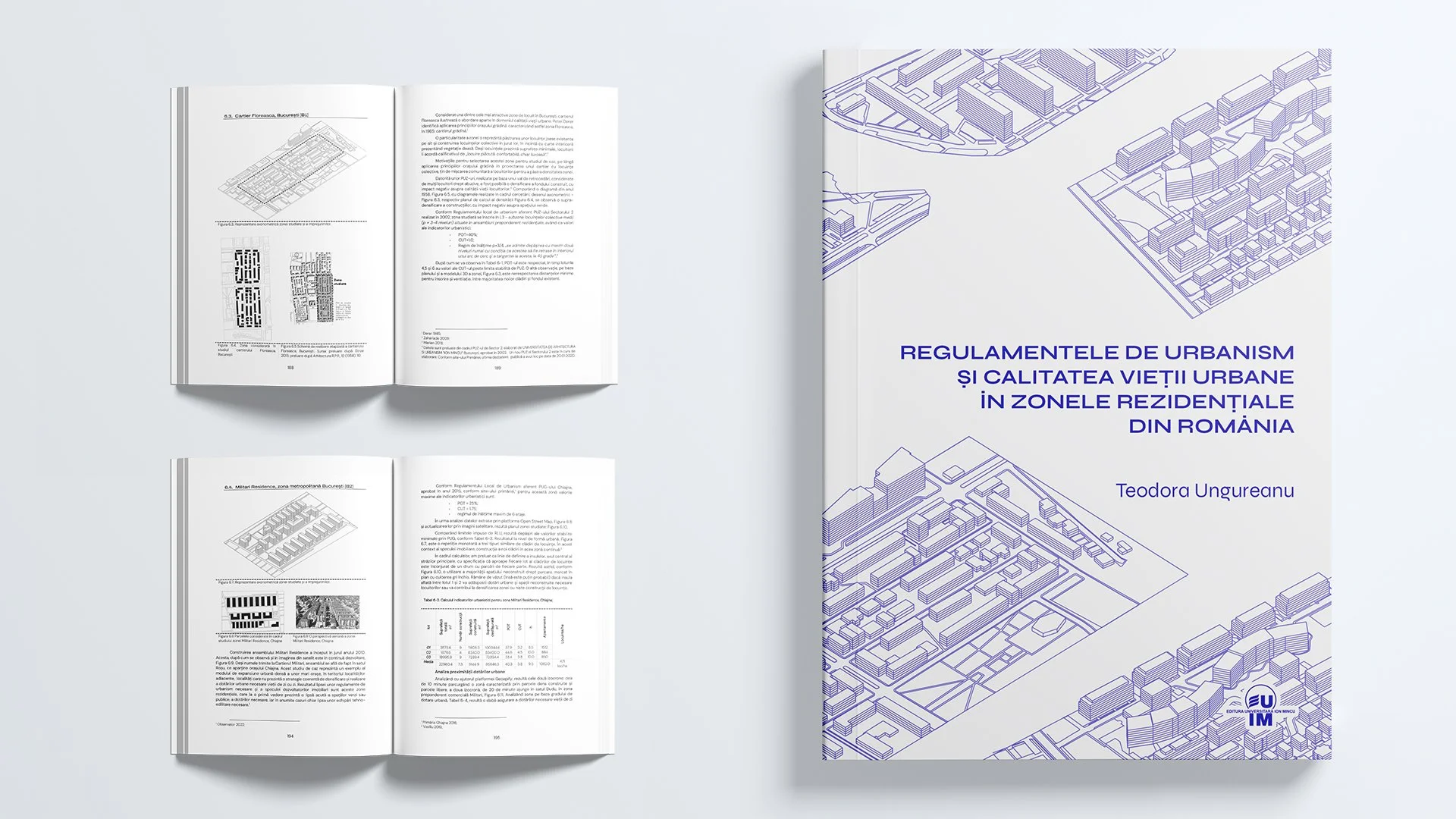
Book: Urban codes and the quality of urban life in Romanian cities
Year of publication: 2023
ISBN 978-606-638-330-1
Publisher: EUIM - Ion Mincu University Publishing House
Type of publication: publication of doctoral research carried out within the UAUIM Doctoral School of Urbanism, 2018-2022, under the guidance of Prof. Dr. Arch. Habil. Adrian Iancu.
Volume published as part of the ExcelDR project - "Promoting excellence in doctoral research in architecture and urbanism"
Many new residential developments in Romania lack essential urban amenities for a good daily life. They are densely built and rely on private vehicles for mobility, in most of the cases ignoring healthier and more environmentally friendly modes of transport. Although they are intended to function as living areas, they fail to become true neighbourhoods: those fragments of the city where daily life can be enjoyed with ease and comfort. According to specialised literature, a neighbourhood is a residential area with complementary functions, key urban amenities, good accessibility, varied densities, and elements that enhance the urban image and foster community attachment and belonging.
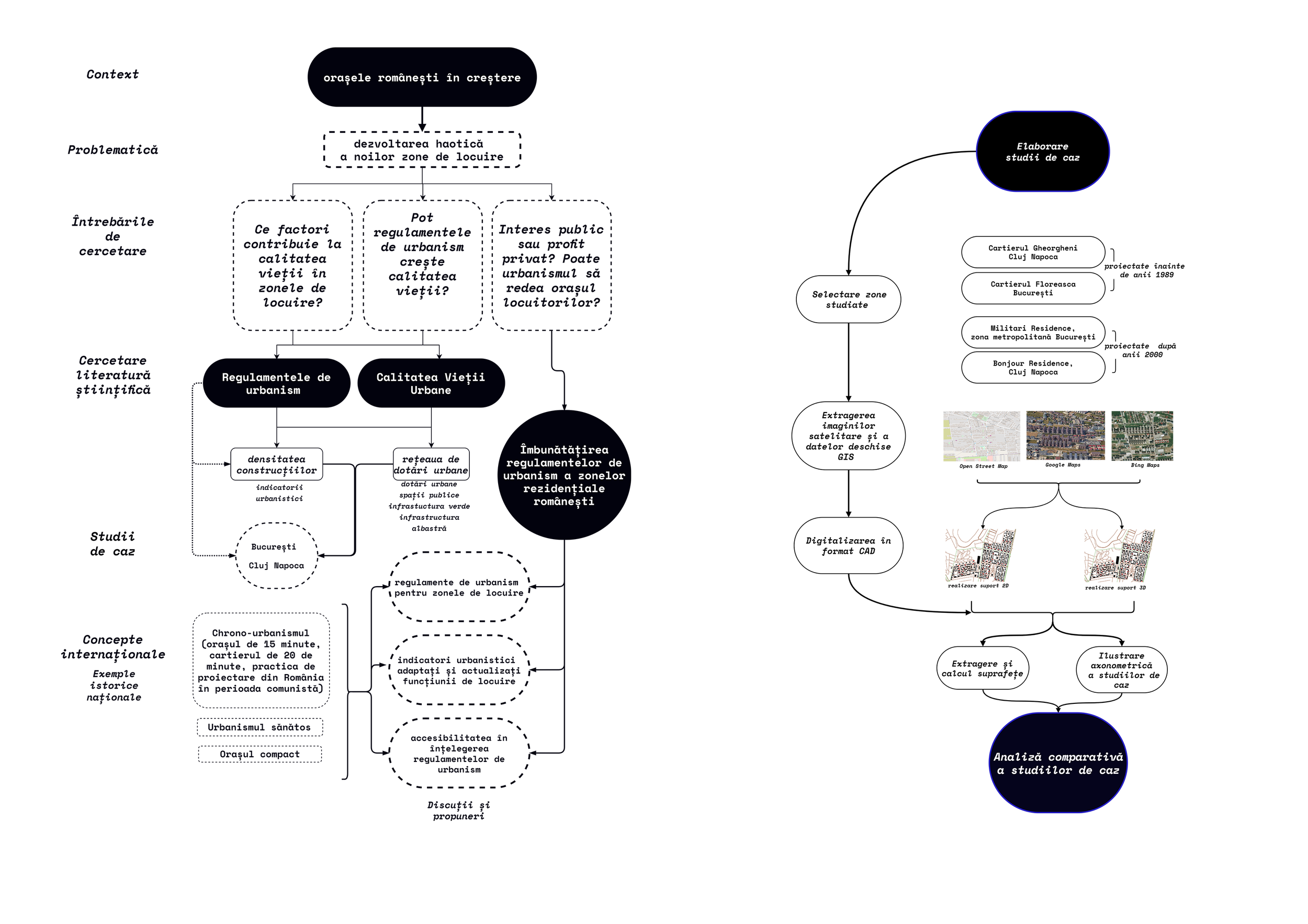
This publication outlines my doctoral research where I analyse how urban planning codes and specialised tools can enhance the quality of urban life in current and future residential developments in Romania. By studying the urban codes as a system and design tool, I investigated the responsibility and interest of a wide spectrum of public and private actors. The research starts with the idea that urban planning regulations should help us build better cities for people. However, today, the main tools of urban density, urban planning indicators, such as ground space ratio and the floor space index, are used almost exclusively to maximise the built-up area, without guaranteeing the quality of life for future residents. In the absence of clear and mandatory regulations regarding urban amenities, pedestrian distances, the minimum proportion of green spaces or public spaces, the quality of new residential areas significantly decrease.
The research findings follow three main directions related to urban planning regulations, urban indicators, urban amenities, and the accessibility and transparency of information regarding urban planning documentation. For the development of functional neighbourhoods, urban codes must be "dynamic", conceived as flexible tools for improving the quality of life, not just as sets of quantitative codes. It is necessary to (re)define and monitor urban indicators, such as the land occupancy index adapted to the residential function, percentage of green space, or urban amenities level, which would provide a more accurate picture of how a residential area functions. In addition to these technical aspects, the involvement of residents is necessary. Therefore, the third direction of the conclusions aims to make the urban planning process more transparent so that it is easier to understand by all urban actors, not just specialists, but also public administration, investors, and especially residents and communities. Turning a residential area into a neighbourhood goes beyond semantics; it requires a unified vision, consistent regulations, and cooperation among urban stakeholders to establish thriving, accessible living environments and foster community development.
The book was nomited at The National Architecture Biennial 2025, Section 16: Architectural publications. [See more here.]